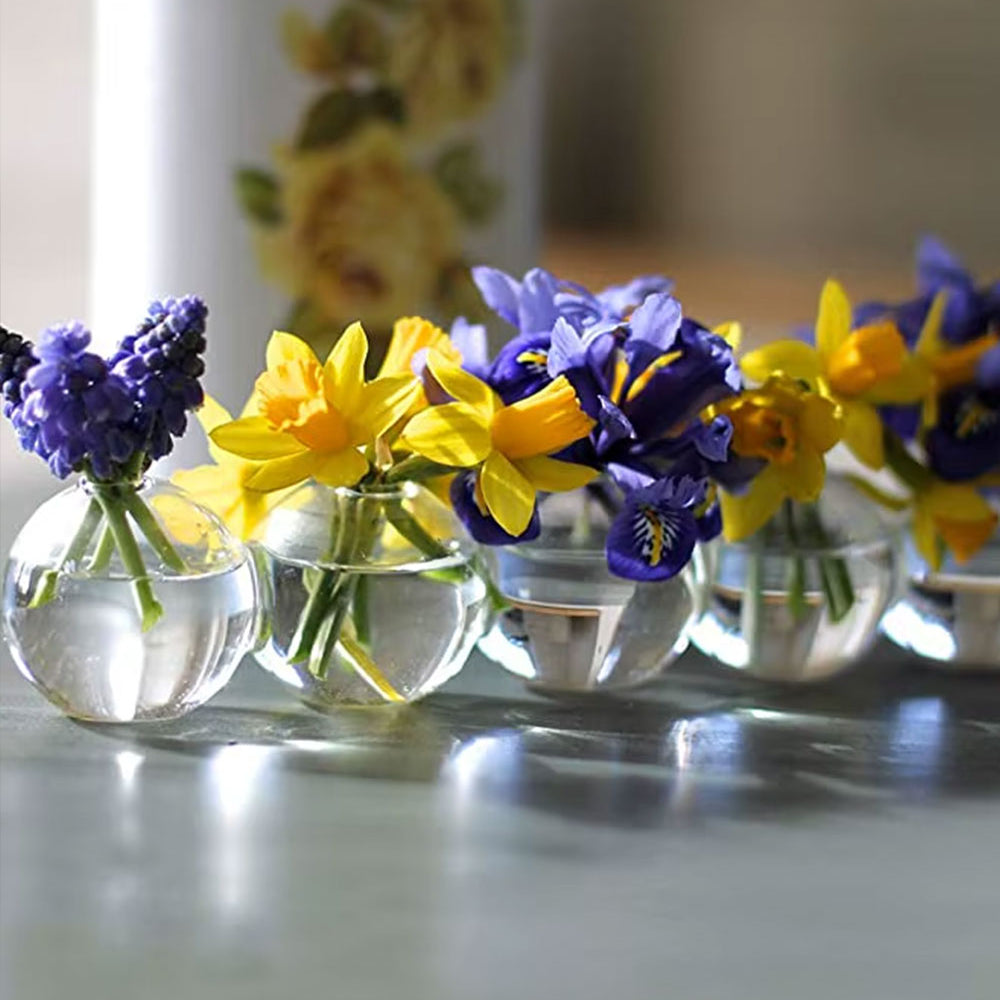
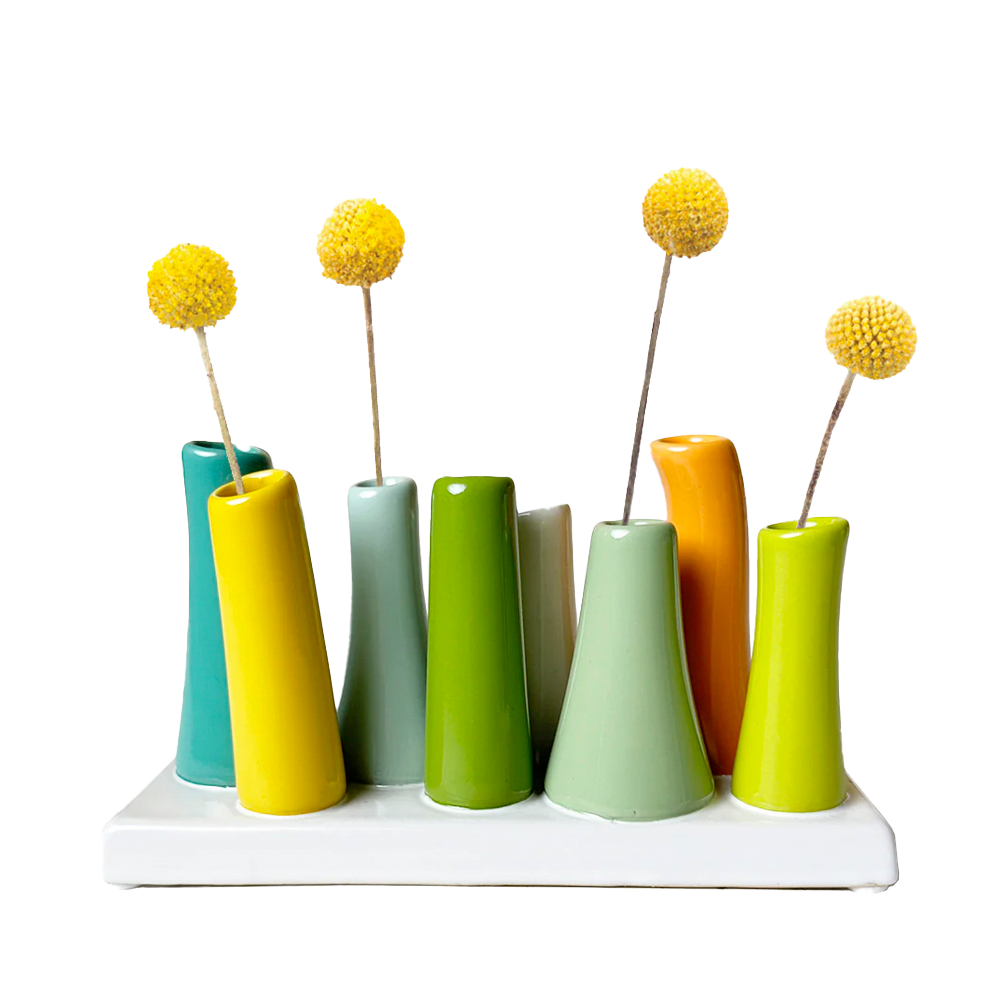
George Glass Clear Bud Vase For Flowers

Regular price $7.95
Shapes
Hand Blown Glass
Dishwasher safe cleaning
30-day return policy

Pickup available at A.N. Deringer c/o Chive Inc

Usually ready in 24 hours


Build the Arrangement That Looks Harder Than It Was

Pick a vase to anchor the shelf, then add the rest until it reads as curated instead of collected.


Buying a george vase online means judging glass from a photograph, and the number that decides the outcome is almost never listed. Height is easy to photograph. The width of the mouth determines whether you get one confident stem or four leaning on each other, and that is the figure nobody publishes. Ours runs narrow on purpose. Five sizes exist, every one between 3.5 and 5 inches tall and every one within half an inch of 3 inches across, so they sit alongside each other on a shelf without any of them winning. A curved bud vase like this earns its keep in the awkward gap: too small for an arrangement, too big for a jam jar. As a clear glass bud vase for flowers it conceals nothing, including the water line, the cut end, and the fact that you had exactly one daffodil worth keeping. Five near-identical vases is not indecision, whatever the sales team has decided to call it.

Product detail

Product Detail:

  • Material: Glass
  • Glaze finish: Translucent
  • Year Designed: 2008
Dimension
  • George 1 is 3" in diameter, 4" tall
  • George 2 is 2.5" in diameter, 5" tall
  • George 3 is 3" in diameter
  • George 4 is 3" in diameter, 4" tall
  • George 5 is 2.5" in diameter, 5" tall
Vase Care Instructions

All glass vases in this collection are dishwasher safe for easy cleaning, with one exception: mercury glass vases should be hand-washed only. The silvered mercury finish is a delicate coating rather than a solid color, and dishwasher heat and detergent can dull or strip it over time.

For standard glass vases, just load it in with the rest of the dishes — no special care needed. For mercury glass pieces, wash gently with warm water and mild soap, and dry with a soft cloth rather than letting it air dry with water spots.

Rinse and dry after each use, especially if flower food or cut-stem residue was in the water, so nothing lingers and clouds the glass.

Flowers that Love this Vase

Quick Guide to Building a Floral Arrangement

  1. Pick your vase first
  2. Start with your anchor flower.
  3. Build in odd numbers.
  4. Add height, then fill.
  5. Greenery does the quiet work.
  6. Cut stems at an angle, underwater if you can.
  7. Step back before you decide it's done.

Canada wide shipping & returns

Shipping 

  • Standard: 5–8 business days, Express 2–3 business days (at checkout)
  • Canada Wide Shipping: from coast to coast — rates at checkout
  • Packaging Ships: in outer box to protect gift box

View full shipping policy →

Returns

We accept returns within 30 days of delivery on unused hard good items in original packaging. If your piece arrives damaged, contact us within 7 days with a photo and we will replace it at no charge.

View full return policy →

Local pickup & delivery

Delivery: 

  • Delivered by hand across Toronto and the GTA. 
  • Next business day; same-day when you call the shop.
  • Local GTA delivery starts at $14
  • Call for a quote outside of the GTA

Pickup: Order online by 3pm and collect it the same day at:

702 Queen St. W.,
Toronto, ON M6J 1E7
437-777-5021

We are open for in-store shopping

Mon to Thurs: 12pm - 7pm
Fri to Sun: 11am - 7pm

Get Directions

Image description

A Wedding, and Every Vase in the Shop Was Square — The George

Todd's sister was getting married and wanted bud vases. Not centrepieces, not arrangements, not anything requiring a florist to be booked or consulted: one flower, one small vessel, repeated down a table. This should have taken an afternoon of shopping. What she found instead was a market divided cleanly into two disappointments. Half of it was cheap in the way that photographs adequately and then arrives feeling like a promotional item. The other half was square, which had been the shape of every modern vase for roughly twenty years by then and had long since stopped meaning anything at all. A square vase is a decision nobody is making any more. It is just what the moulds already exist for. Nobody at the wedding said a word about the vases, which is the correct outcome. So we drew one with a curve in it, made enough for the tables, and she was pleased, and we were more pleased than she was, which is the part nobody admits about doing a favour. Five sizes exist now because once you have solved one bud vase properly you start noticing all the stem lengths it does not suit. The wedding was in 2008. The drawing has not changed since.

How to Cut Flowers Like a Pro:

A (Mostly) Simple Guide to Cutting Your Flowers

So, you’re making an arrangement? Let’s ensure it lives long enough to impress someone—even if it's just you.

  1. Scrub the Scissors: Wash your shears first. Your flowers do not want a side of Dorito dust.
  2. Cut at 45°: Snip stems at an angle. It gives them a straw instead of making them chug from the bottle.
  3. Trim Underwater (Fancy Mode): Cut them submerged to block air bubbles. It’s extra, but they didn’t ask to suffocate.
  4. Ditch Submerged Leaves: Strip anything below the waterline. Unless you are actively going for a swamp aesthetic.
  5. Snip Again if Stale: If they sat out on the counter, trim them again. They need a fresh start (don’t we all?).
  6. Swap the Water: Change it and trim the stems every few days so they don't die immediately.

Voilà! You are now a domestic deity. Go take your Instagram photo before you forget to water them.

Pro Tip: The light does half the work.

Glass catches and bends light in a way ceramic can't. Set the arrangement somewhere it'll get some late afternoon sun, even for an hour, and the water and stems start doing something a solid vase never will.

Perfect Pairs for Any Shelf

Image description

The Same Problem, Solved Vertically

The glass vases at Chive come out of the same studio habit that produced everything else here: design the object once, correctly, then resist every opportunity to complicate it. Each one holds stems. None of them hides anything.

This one has been in production since 2008 without a single alteration to the drawing. If the surface it needs to occupy is vertical rather than horizontal, the Hanging Airplane Cable & Glass Vase solves the identical problem by hanging five tubes off aircraft cable instead.

Everything Follows From The Opening

Every Chive vase is built around one decision about how flowers should stand, then finished by hand until that decision reads as obvious.

For the George, that decision was the mouth. Make it too generous and one stem lolls sideways overnight; make it tight and the flower holds whatever angle you gave it for as long as the water lasts. Everything else about the piece follows from that opening, including the curve, which exists to give a leaning stem somewhere to lean. Five sizes came later, and for a reason we still argue about. Other decisions, other shapes are shelved nearby.

One Clean Head Per Stem, For Weeks

A packet of Ranunculus Flower Seeds is the practical companion to a single-stem vessel, because ranunculus produces one clean upright head per stem and keeps producing them for weeks. Cut in the morning, one at a time, and there is always something for the shelf. Grow a row of them and you will need more than one George.


We Retire Almost Nothing

Since 2004 this studio has retired almost nothing. A design that works stays in production, and the George has been made continuously for eighteen years without an alteration to the original drawing, which is odd enough that buyers occasionally ask whether it is new. The reasoning is not sentimental. Every shape here gets drawn, sampled and argued over long before anybody may run it in quantity, so the real cost sits at the front rather than in the repetition afterward. Once that cost is paid, pulling something from the range to make room for a novelty is a decision we can rarely justify. The catalogue therefore grows in one direction only. Some of it has been on the shelf longer than the staff have.


Inside the Chive Design Studio

Low maintenance, high impact. Let's make home styling look easy.


Frequently asked questions

What should you look for when buying a George vase online?

Three things. Whether the listing gives an interior mouth measurement rather than only a height, because height tells you nothing about what will stand up in the thing. Whether the base carries weight, since a light vessel topples under one heavy stem. And whether any photograph shows it beside a familiar object for scale. Most listings fail all three of those tests. Ours publishes the mouth.

What flowers work best in the George vase from Chive?

One stem with a head worth looking at. A gerbera daisy, a single rose, a daffodil in March, one chrysanthemum in the weeks when nothing else is available. The tight opening keeps it at whatever angle you set instead of letting it drift against the side by morning. Larkspur, flowering dill and borage will take a group of three. Woody stems will not.

What are the George vase's dimensions for shelf or table display?

Five sizes. George 2 is the tallest at 5 inches and George 5 the shortest at 3.5, with the three in between separated by fractions. Diameters run at either 2.5 or 3 inches. On a shelf you register the variation only when two are standing side by side, and on a dining table you do not register it at all. Choose by stem length rather than by number.

Does glass keep flower water fresher in the George vase?

Glass absorbs nothing, which is the honest version of that claim. There is no glaze to craze and no unsealed interior for residue to settle into, so a washed vessel is genuinely clean instead of approximately clean, and that slows the bacteria which shorten a cut stem. What glass will not do is change the water for you. That part is yours.

How often should you change the water in the George vase?

More often than a large vessel, for a reason unrelated to cleanliness. The reservoir here is tiny, so one stem drinks a measurable share of it inside a day and the level drops far enough to leave the cut end dry by the third morning, which is what actually kills the flower. Replace it outright twice a week and check the level daily. Ten seconds, standing up.

Can the George vase anchor a dining table or entryway console?

Not by itself, and it was never meant to. A four-inch vessel alone on a long table reads as something somebody forgot to clear away. A run of them down the centre line, one stem in each, is a different proposition entirely and the arrangement we would suggest. On a narrow console a pair does more work than one. Scale comes from repetition, not from size.

Which holds more stems, the George vase or the Airplane vase?

The Airplane, though only because it is five vessels rather than one. Each of its tubes takes a single stem and the largest configuration therefore carries five. This holds one, or three when they are slender enough to share an opening without crowding each other out. Measured per opening the two are near identical. The Airplane just has more openings.

Who designed the George vase and what inspired its shape?

Todd drew it in 2008. The brief was narrow: a bud vase that curved, because everything on offer at the time was either a straight tube or a square block and both looked like something ordered from a supply catalogue rather than chosen for a table. The curve does one practical job, which is holding a leaning stem at the angle it fell. Beyond that it is preference.

Behind the Studio

The story behind the Chive astronaut vases

The story of Laika, Félicette, a solar eclipse in New York, and a space bar that ordered a hundred vases a month until it closed.